Lina Odena as a Miliciana in the Spanish Civil War
The miliciana are heroic women fighters during the Spanish Civil War. They were heroic figures that became a symbol of the mobilization of the Spanish people against fascism. Lina Odena was the most well-known miliciana during this time.
She demonstrated the violent actions during the antifascist resistance. She practiced antifascism as a communist activist and in combat in the front-lines during the civil war.
Spanish Civil War Context
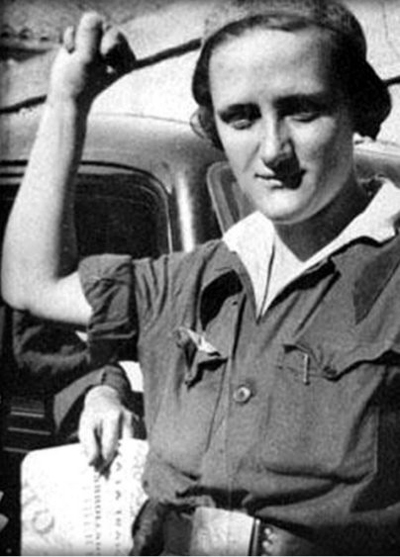
Photograph of Lina Odena taken between July and September 1936, shortly before her death.
The Spanish Civil War was fought between the Republicans and the Nationalists. The Republics were led by General Francisco Franco and the Nationalists were the rebels. Franco was backed up by Nazi Germany and Fascist Italy. He planned to bring these ideals to Spain. The Nationalists fought against Franco because they didn’t want a dictatorship.
The Spanish Civil War was triggered on July 13, 1936 with the assassination of anti-republican leader Jose Calvo Sotelo. He was assassinated in retaliation. On July 18, 1936, the nationalist military had a rebellion and uprising. The republic failed to crush the rising in the first 48 hours which is the start of the war.
Fascism was brought during the civil war by Franco. His regime began to repel legislation that expanded women’s rights. Women were imprisoned, exiled, and executed when resisting. Women started to fight in the civil war and against fascism with the introduction of Franco’s fascist ideas.
Early Life
Odena was born on January 22, 1911 in Barcelona, Spain. She was an active member of the Spanish Communists Party and participated in politics. This party had been barely developed before the Civil War but she was an active participant. She was the leader of the Juventudes Socialistas Unificadas (JSU), which is the Communist Youth Movement. This organization was a part of the Communist Party in Spain.
She was also the Secretary General of the National Committee of Antifascist Women. Her participation in these organizations had her recognize the threat of fascism before it travelled to her home.
Her leadership in these two groups had her travel to various sectors of the granda front. This traveling brought her to areas where she would eventually join in combat during the civil war.
Life on the Front Lines
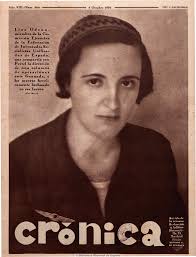
Photograph of Lina Odena taken between July and September 1936, shortly before her death.
As a miliciana, she helped organize other milicianas in Almeria. She travelled to many different areas, some that she had visited before when she was a part of the communist organizations, and others that were entirely new to her. She led groups of milicianas into battle and accompanied them on the front lines. Some specific areas she fought was in the south of Spain, including various sectors of the Grana Front and in Guadix.
She was able to achieve the post of commandant somewhere along her career by her prior experience in leadership. Her leadership skills in the Juventudes Socialistas Unificadas and the National Committee of Antifascist Women applied to her leadership of her fellow milicianas.
Impact After Death
Odena died on the Granda front in the Guadix sector on September 13, 1936. She and a fellow companion were driving when they took a wrong turn. They approached an army checkpoint with Falangist soldiers. After trying to get away, she and her companion shot themselves in the head in fear of being taken prisoner. When captured, torture was expected to happen.
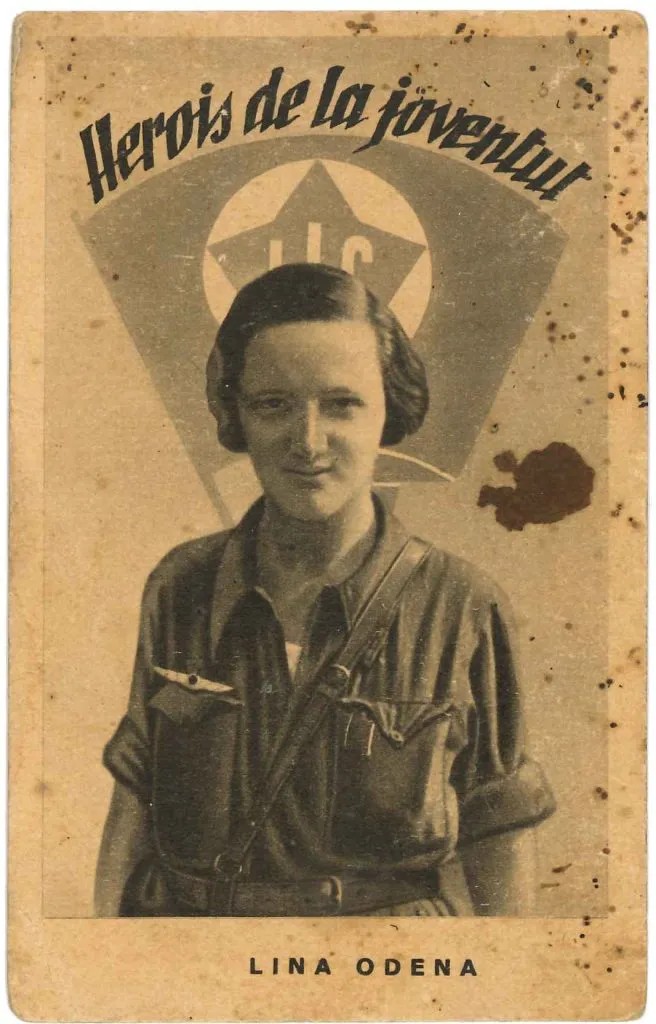
Front of card with a picture of Lina Odena. Lluís Serra Sancho Collection.
Her death was presented as death in action and was constantly evoked as the archetype of female heroism. She was viewed as a war legend and a propaganda weapon. She exemplified the war rhetoric of the message of courage and bravery of resistance within the Spanish Civil War. Her suicide was reported in communist, socialist, and independent press as a brave and noble act.
A battalion was named after her and her face was printed on cards, calendars, and stamps. She was on Communist postcards with the caption “Heroine of the Youth”. The postcard on the left depicted Odena in the center with the JSU flag and the caption behind her.
These cards were used to influence other women and communists to fight in the war and join Odena with their bravery.
Many pieces of artwork were influeced by her. One piece by J.Pons, who made an oil painting portrait of Odena in her miliciana overalls (photo 1 below). Other pieces depicted miliciana woman to call people to help them fight (photo 2 below). Even photography of miliciana women were taken (photo 3 below). Odena’s popularity brought attention to the milicianas as a whole.
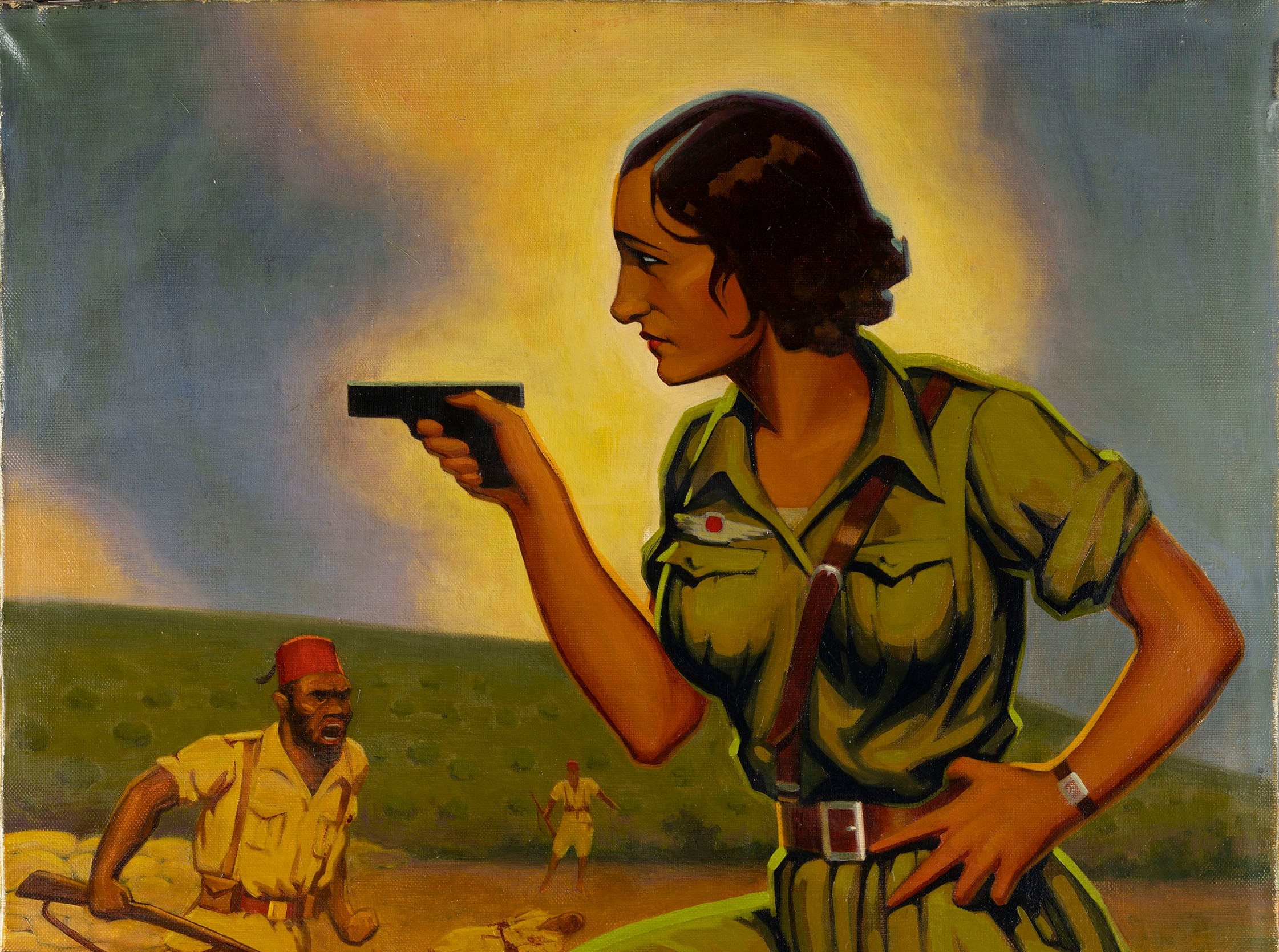
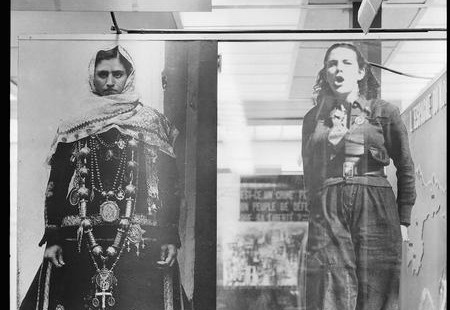
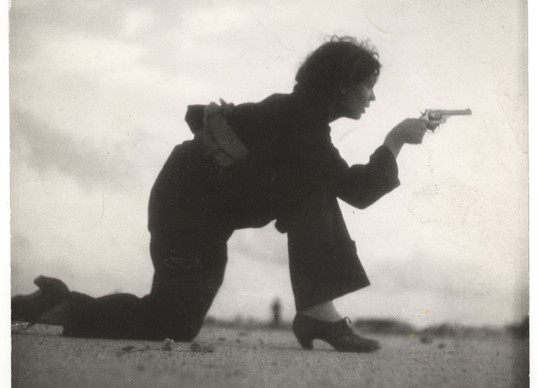
These mythologies after her death, feminized her by focusing on her feminine virtues and framed her sucicde as a decision to protect her virtues against rape. Her effort in combat was just as important. Her contribution on the front lines inspired other women to take action and join the miliciana team during the Spanish Civl War.
Sources:
Broue, Pierre, & Emile Temime. The Revolution and the Civil War in Spain. La revolution et la guerre d’Espagne, 1970.
Lines, Lisa. Female Combatants in the Spanish Civil War: Milicianas on the Front Lines and in Rearguard. Journal of International Women’s Studies, 2009.
Melvor, Jessica Elizabeth. Photography, War and Gender: Redefining Women’s Militancy During and After Conflict in Ireland and Spain. PhD diss, 2022.
Nash, Mary. ‘Milicianas’ and Homefront Heroines: Images of Women in Revolutionary Spain (1936-1939) History of European Ideas 11, 1989.
Valles, Eduard. Lina Odena, the legend of the militiawoman who committed suicide, and the mayor of el prat. Museu Nacional D’Art De Catalunya, 2023.